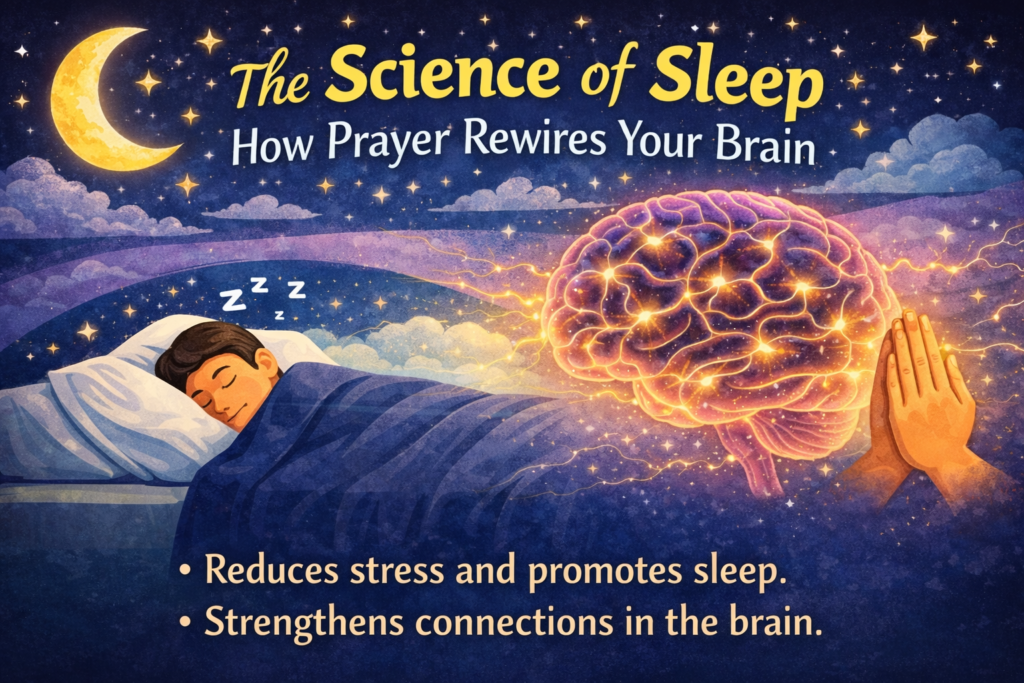
We often view prayer as a purely spiritual activity, distinct from our physical bodies. But God designed your body and soul to be intricately connected. Science is now catching up to what Scripture has taught for thousands of years: what you do with your mind physically changes your brain.
If you are looking for practical steps to stop the spiral of worry, check out our 3-step guide on Faith Over Fear.
The Cortisol Cycle
When you lie in bed with a racing mind, your body is likely stuck in a “sympathetic nervous system” response—commonly known as “fight or flight.” Even though there is no lion in the room, your anxious thoughts signal to your amygdala (the brain’s threat detection center) that you are in danger. Your body responds by pumping out cortisol and adrenaline. This chemical cocktail is like caffeine for your nerves; it raises your heart rate and body temperature, making deep sleep physiologically impossible.
The “Rest and Digest” Switch
This is where our evening prayer guide becomes a physiological intervention. When you engage in slow, rhythmic prayer or meditation on Scripture, you activate the “parasympathetic nervous system”—the “rest and digest” mode. If racing thoughts are the specific issue keeping you awake, our bedtime prayers for a racing mind are written specifically for that battle.
Research shows that gratitude, specifically, reduces cortisol levels by up to 23%. When you shift your focus from what is wrong (anxiety) to who God is (worship), you are literally flipping a switch in your nervous system. You are sending a “safety signal” to your brain.
By intentionally slowing your breathing and repeating Scripture, you are physically telling your heart: “The war is over. You are safe. You can power down now.”
Overthinking is one of the most spiritually exhausting battles a believer can face. The mind left unchecked will rehearse worst-case scenarios, revisit past failures, and manufacture fears about a future that has not yet arrived. What makes this battle so dangerous is that it rarely announces itself — it disguises itself as careful planning, wisdom, or responsibility, while quietly eroding your peace and your trust in God. Scripture, however, does not leave you without weapons. The bible verses for anxiety and overthinking that appear throughout both the Old and New Testament were written by people who understood what it meant to carry an unbearable mental load — and who discovered that surrendering that load to God was not weakness, but the highest act of faith available to them.
Philippians 4:8 is perhaps the most direct biblical instruction for the overthinking mind: “Whatever is true, whatever is noble, whatever is right, whatever is pure — think about such things.” This verse is not a polite suggestion; it is a command to actively redirect your thought life. God understands that what occupies your mind ultimately shapes your faith, your decisions, and your peace. Pairing these verses with an intentional bedtime prayer routine creates a powerful nightly reset — training your mind to release the day’s worries and anchor itself in God’s truth before sleep. Over time, consistently meditating on Scripture rewires the patterns of anxious thought, replacing the noise of overthinking with the quiet confidence that comes from a mind stayed on God.
Soothing Bible Verses for Anxiety

We have already explored the power of Philippians 4, 1 Peter 5, and Psalm 94. Here are the remaining scriptures to complete your arsenal of peace. I encourage you to bookmark this list. On nights when the anxiety is specific, look for the verse that matches your need.
1. Philippians 4:6-7 (The Great Exchange) “Do not be anxious about anything, but in everything by prayer and supplication with thanksgiving let your requests be made known to God. And the peace of God, which surpasses all understanding, will guard your hearts and your minds in Christ Jesus.”
- The Promise: This is a trade. You give God your anxiety (supplication) and your gratitude; He gives you a guard. The Greek word for “guard” here is a military term. It means God sets a sentry at the door of your mind to say, “You cannot pass” to the fears that try to invade.
- The Practice: Visualize a sentry standing guard at your bedroom door. Every time a worry tries to enter, imagine the sentry blocking it.
- Bedtime Prayer: “Lord, I am trading You my heavy thoughts for Your peace. I place [name your specific worry] into Your hands. Please station Your peace at the door of my mind tonight. Guard my sleep so I can rest in You. Amen.”
2. 1 Peter 5:7 (Casting Cares) “Casting all your anxieties on him, because he cares for you.”
- The Promise: The word “casting” here isn’t a gentle toss; it means to throw something upon something else. Imagine you are hiking with a 50-pound backpack. This verse is the invitation to physically heave that pack onto Jesus’ shoulders.
- The Practice: Before you get into bed, stand next to it. Mime the action of taking a heavy weight off your shoulders and throwing it onto the bed. Physically acting this out can help your mind register the spiritual reality.
- Bedtime Prayer: “Jesus, this burden is too heavy for me. I am not designed to carry the weight of the world, but You are. I cast this specific worry onto You right now. I trust You to handle it while I sleep. Amen.”
While these verses offer great comfort, sometimes anxiety feels like a direct attack on your peace. If you feel like you are in a spiritual battle, we recommend using these spiritual warfare prayers to fight back. Our prayer against night fear is also a powerful tool specifically for the fear and dread that surfaces at bedtime.
3. Psalm 94:19 (Consolation) “When the cares of my heart are many, your consolations cheer my soul.”
- The Promise: God doesn’t just tolerate you when you are overwhelmed; He comforts you. He is near to the brokenhearted and those with a racing mind.
- The Practice: Identify one “consolation” (something good God has done) for every “care” you feel. Match every negative thought with a positive memory of God’s faithfulness.
- Bedtime Prayer: “God, the noise in my head is loud tonight. There are so many cares. But I choose to listen to Your whisper instead. Thank You for being my comfort. Cheer my soul with the reminder that You are in control and I am not. Amen.”
4. Isaiah 26:3 (The Anchor) “You will keep him in perfect peace whose mind is stayed on you, because he trusts in you.”
- The Promise: The Hebrew phrase for “perfect peace” here is actually Shalom Shalom. It is a double portion—peace upon peace. The condition? A mind “stayed” on God. The word “stayed” implies leaning your entire weight upon something, like a sailor leaning against the mast during a storm.
- The Practice: Imagine your mind is a ship tossing on the waves of anxiety. Now, imagine throwing a heavy iron anchor into the deep water. That anchor is the character of God.
- Bedtime Prayer: “Lord, my mind is drifting tonight. I feel the waves of worry. But right now, I choose to ‘stay’ my thoughts on You. I lean my full weight into Your faithfulness. You are my stabilizer. I receive Your double portion of peace tonight. Amen.”
5. Matthew 6:34 (The Sacred Present) “Therefore do not be anxious about tomorrow, for tomorrow will be anxious for itself. Sufficient for the day is its own trouble.”
- The Promise: Jesus isn’t dismissing your problems; He is creating a boundary for them. Grace is like “daily bread”—it is baked fresh every morning. You cannot store up grace for tomorrow’s problems today. When you worry about tomorrow, you are trying to spend grace you haven’t received yet.
- The Practice: Draw a mental line in the sand. When a thought about tomorrow crosses it, say gently, “Not yet. I have grace for this moment, not that one.”
- Bedtime Prayer: “Jesus, I am trying to live in the future. I am trying to solve problems that haven’t happened yet. Help me come back to right now. Thank You for getting me through today. I trust You to meet me in tomorrow when I get there. Amen.”
6. Psalm 23:1-3 (The Shepherd’s Lead) “The Lord is my shepherd; I shall not want. He makes me lie down in green pastures. He leads me beside still waters. He restores my soul.”
- The Promise: Sheep don’t lie down if they are afraid, hungry, or agitated by pests. If the sheep is lying down, it proves the Shepherd has handled every threat. Your ability to rest is a testament to His ability to lead.
- The Practice: Go through the verse slowly. Identify what you “want” (lack) right now. Safety? Direction? Comfort? Then declare that the Shepherd is those things for you.
- Bedtime Prayer: “Good Shepherd, I feel like I am lacking so much. But You are my provider. Lead me out of this dry valley of fear and beside the still waters. I am safe in Your care. Make me lie down in peace. Amen.”
7. 2 Timothy 1:7 (The Sound Mind) “For God gave us a spirit not of fear but of power and love and self-control (sound mind).”
- The Promise: Fear is not a personality quirk; the Bible calls it a “spirit.” But it’s a spirit that doesn’t belong to you. Your inheritance as a child of God is a “sound mind”—a mind that is disciplined, calm, and under control.
- The Practice: When you feel your thoughts spinning out of control, identify the fear as an intruder. Speak out loud: “This fear is not mine. God didn’t give me this.”
- Bedtime Prayer: “Father, I reject this spirit of fear. It is not my inheritance. I claim the sound mind You promised me. I put on the helmet of salvation to protect my thoughts. Fill me with Your power and Your love as I sleep. Amen.”
8. Zephaniah 3:17 (The Singing God) “The Lord your God is in your midst, a mighty one who will save; he will rejoice over you with gladness; he will quiet you by his love; he will exult over you with loud singing.”
- The Promise: This is perhaps the most tender verse in Scripture. It depicts God as a Father soothing a crying child. He doesn’t just watch you; He sings over you. His love is the volume knob that quiets the noise of the world.
- The Practice: Silence. Stop talking. Stop asking. Just lie still and imagine the Almighty God humming a lullaby of affection over your life.
- Bedtime Prayer: “God, I am usually the one talking, but tonight I need to listen. Quiet me with Your love. Hush the noise of my accusations and regrets. I receive Your song of delight over me. Amen.”
9. John 14:27 (The Distinct Peace) “Peace I leave with you; my peace I give to you. Not as the world gives do I give to you. Let not your hearts be troubled, neither let them be afraid.”
- The Promise: The world’s peace is “escapism”—binging TV, scrolling phones, numbing out. Jesus’ peace is “equipment.” He gives you His own peace—the same peace He had sleeping in the boat during the storm.
- The Practice: Identify your “false peace.” Are you scrolling to numb out? Put it away and ask for the real thing.
- Bedtime Prayer: “Lord, I have been looking for peace in distraction. But that peace is fragile. I want Your peace—the kind that survives the storm. I accept Your gift. Calm my troubled heart. Amen.”
10. Psalm 46:10 (The Command) “Be still, and know that I am God.”
- The Promise: The Hebrew root for “be still” is raphah, which means “to drop, to let go, to slacken.” It’s the image of dropping your hands to your sides. It is a command to stop striving, stop fighting, and stop trying to be God.
- The Practice: Clench your fists tight for 5 seconds, representing your control. Then, on an exhale, open them wide and say, “I drop it.”
- Bedtime Prayer: “God, I am tired of fighting. I am tired of trying to hold the world together. I drop my hands. I resign as master of the universe tonight. You are God, and I am not. And that is enough. Amen.”
Can’t Sleep? If your racing thoughts are keeping you awake, read our guide on Bible Verses for Sleep: 12 Calming Scriptures for Insomnia. You can also pair these verses with a prayer for peaceful sleep or a bedtime prayer for protection to fully cover your night in God’s peace.
Overthinking rarely stays contained to one area of life — it bleeds into your sleep, your relationships, your decision-making, and your ability to trust God in seasons of uncertainty. If these two paragraphs have resonated with you, our post on bible verses about overthinking goes much deeper, walking you through the most powerful scriptures for quieting a restless mind, with practical guidance on how to apply each verse in your daily thought life. Whether you are in the middle of a sleepless night or a prolonged season of mental exhaustion, that guide was written specifically to help you move from a mind that races to a mind that rests.