The world is loud, isn’t it? But sometimes, once the house is quiet and the lights are out, our internal world becomes even louder. You know the feeling—the tightening in the chest, the shallow breathing, the racing thoughts that replay yesterday’s mistakes and borrow tomorrow’s troubles.
When anxiety hits at night, it can feel isolating. You might feel like you are the only one awake, wrestling with a mind that refuses to shut down. But God has given us a tool specifically designed to pierce through that noise: The Book of Psalms.
These aren’t just ancient poems; they are God’s medicine cabinet for the human emotion. They are “spiritual prescriptions” written to recalibrate your nervous system and anchor your drifting soul. Tonight, we aren’t just going to read verses; we are going to use them as a lifeline.
If you are looking to build a consistent rhythm of peace, these scriptures are a perfect starting point. You can also pair them with our guide on nighttime prayer routine to turn these verses into a nightly conversation with God.
Why the Psalms Are the Best Antidote for Anxiety
If you grew up in church, you might think of the Psalms as polite songs we sing on Sunday mornings. But if you look closer, you will see that the Psalms are actually raw, gritty, and incredibly honest. They are the journals of men who were often in desperate situations—hiding in caves, running from enemies, or feeling completely abandoned.
You Are Not Alone (The Honesty of David) One of the reasons anxiety feels so heavy is the shame that often comes with it. We think, “If I were a better Christian, I wouldn’t feel this way.” But then we meet David—a man after God’s own heart—who wrote, “Why is my soul downcast? Why so disturbed within me?” (Psalm 42:5).
David didn’t suppress his panic; he brought it to the surface. By reading Psalms for anxiety, you are validating your own experience. You are realizing that having anxiety doesn’t mean you have bad faith; it just means you are human. The Psalms give you permission to be messy and scared in the presence of God. They remind you that God isn’t looking for a polished prayer; He is looking for an honest one.
The Rhythm of Peace There is also a physiological reason why biblical meditation for stress works so well with the Psalms. They are poetry. They have a meter and a rhythm.
When we are anxious, our thoughts become erratic and fast. Reading the rhythmic, structured lines of a Psalm forces our brain to slow down. It acts as a brake pedal for a racing mind. As you read the repetitive assurances of God’s love, you are literally retraining your breath and your brainwaves to match the cadence of peace.
How to Use This List (Don’t Just Read—Ingest)
Before we get to the specific scriptures for panic attacks and worry, we need to talk about how to read them.
When we scroll social media or read the news, we skim. We consume information quickly to move to the next thing. But if you skim these Psalms, they won’t help you. You cannot rush peace. To truly calm your heart tonight, you need to shift from “reading” to “ingesting.”
The “Selah” Technique You have probably seen the word Selah scattered throughout the Psalms. Scholars aren’t 100% sure what it means, but most agree it is a musical notation meaning “pause and reflect.” It is an instruction to the musicians to stop playing and let the echo of the words hang in the air.
Tonight, create your own Selah moments.
Don’t read the whole Psalm at once. Read one line. Then, close your eyes. Take a deep breath in, and as you exhale, let that one line settle into your chest.
- Read: “The Lord is my Shepherd.”
- Selah: (Pause. Breathe. Visualize the Shepherd standing guard).
- Read: “I shall not want.”
- Selah: (Pause. Breathe. Let go of the striving).
Personalizing the Text To make these calming Bible verses for sleep effective, you have to make them yours. The Bible often speaks to “us” or “Israel,” but tonight, God is speaking to you.
Change the pronouns.
- Instead of “God is our refuge and strength,” say “God is my refuge and strength.”
- Instead of “He leads his people,” say “He leads me.”
When you personalize the Scripture, it stops being a history lesson and starts being a love letter. It shifts the theology from your head to your heart, which is exactly where the anxiety is living.
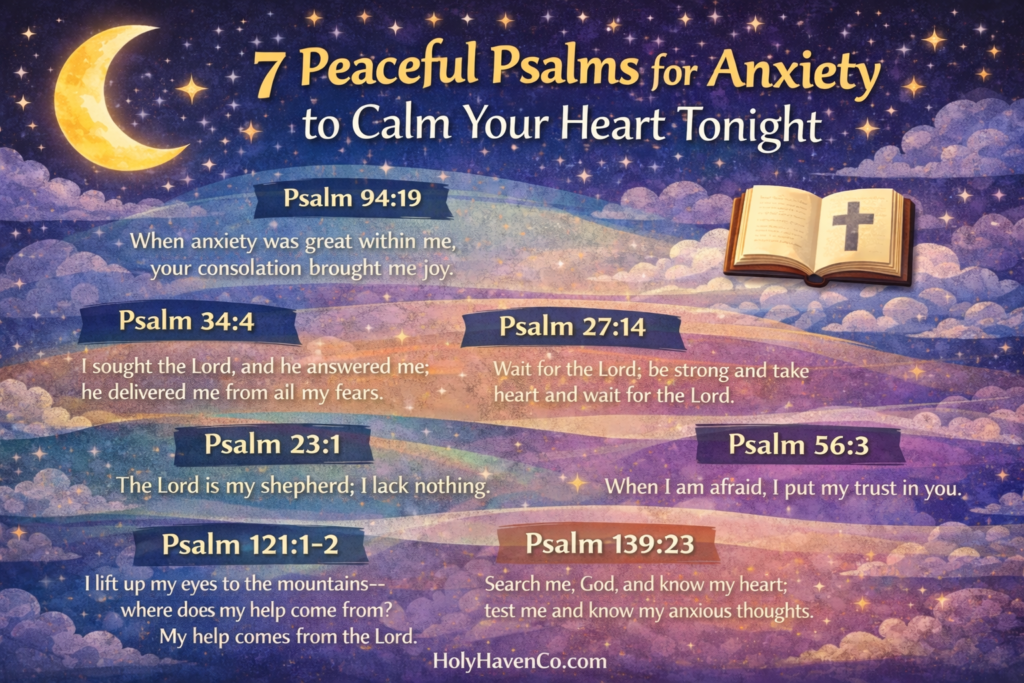
7 Peaceful Psalms for Anxiety (The Core Content)
Now that we have prepared our hearts, let’s look at the specific medicines God has provided. These calming Bible verses for sleep have been anchors for millions of believers for thousands of years. They held David in the cave; they can hold you in your bedroom.
1. Psalm 23: The Psalm of Presence “The Lord is my shepherd; I shall not want. He makes me lie down in green pastures. He leads me beside still waters.”
- The Medicine: Anxiety often screams, “You are alone! You have to figure this out!” This Psalm counters that lie with the truth of Leadership. You don’t have to know the way; you just have to know the Shepherd. The pressure is off you to find the “green pastures”; it is His job to lead you there.
- Bedtime Prayer: “Shepherd of my soul, I resign as the leader of my life tonight. I trust You to lead me. Make me lie down in Your peace. I am safe because You are near. Amen.”
2. Psalm 91: The Psalm of Protection “He will cover you with his pinions, and under his wings you will find refuge… You will not fear the terror of the night.”
- The Medicine: This is the ultimate scripture for God’s protection at night. If you struggle with night terrors or a feeling of vulnerability in the dark, visualize yourself as a small bird tucking under the massive, impenetrable wing of an eagle. The storm may rage outside, but under the wing, it is dry and warm.
- Bedtime Prayer: “Lord, I hide myself in You. Cover my mind and my home with Your wings. I rebuke the terror of the night and claim Your supernatural protection over my sleep. Amen.”
3. Psalm 46: The Psalm of Surrender “God is our refuge and strength, a very present help in trouble… Be still, and know that I am God.”
- The Medicine: The command to “be still” (raphah) literally means to “drop your hands.” It’s the image of a soldier putting down his weapon. Anxiety is a battle; this Psalm is the permission to stop fighting and let God be God.
4. Psalm 94: The Psalm of Consolation “When the cares of my heart are many, your consolations cheer my soul.”
- The Medicine: God acknowledges that sometimes the cares are “many.” He doesn’t gaslight you. He meets your noise with His cheer.
5. Psalm 121: The Psalm of the Watchman “I lift up my eyes to the hills. From where does my help come? My help comes from the Lord… He who keeps you will not slumber.”
- The Medicine: Insomnia is often caused by a subconscious belief that if we stop watching the door, something bad will happen. This Psalm reminds us that God is the “Watchman.” He is on the night shift. Because He is awake, you have permission to go unconscious.
- Bedtime Prayer: “Father, I thank You that You are the Watchman who never sleeps. You are guarding my life, my home, and my future right now. I officially clock out. I rest because You are working. Amen.”
6. Psalm 27: The Psalm of Confidence “The Lord is my light and my salvation; whom shall I fear? The Lord is the stronghold of my life; of whom shall I be afraid?”
- The Medicine: Anxiety thrives on “phantom fears”—vague senses of doom. David combats this by shifting his focus from the size of the fear to the size of his God. When the Light is on, the shadows in the room disappear.
- Bedtime Prayer: “Lord, You are my stronghold. When my thoughts try to terrify me, I will remind them of who You are. You are bigger than this worry. You are brighter than this darkness. I refuse to be afraid. Amen.”
7. Psalm 139: The Psalm of Being Known “You hem me in, behind and before, and lay your hand upon me… If I say, ‘Surely the darkness shall cover me,’ … even the darkness is not dark to you.”
- The Medicine: Sometimes anxiety comes from feeling isolated or misunderstood. This Psalm promises that you are “hemmed in” by God. You cannot wander so far into panic that He cannot find you. Even in the dark night of the soul, He is there.
- Bedtime Prayer: “God, thank You that I am never alone. You know every anxious thought I have, and You love me anyway. Hem me in with Your peace tonight. Let Your presence wrap around me like a blanket. Amen.”
Turning These Psalms into Bedtime Prayers
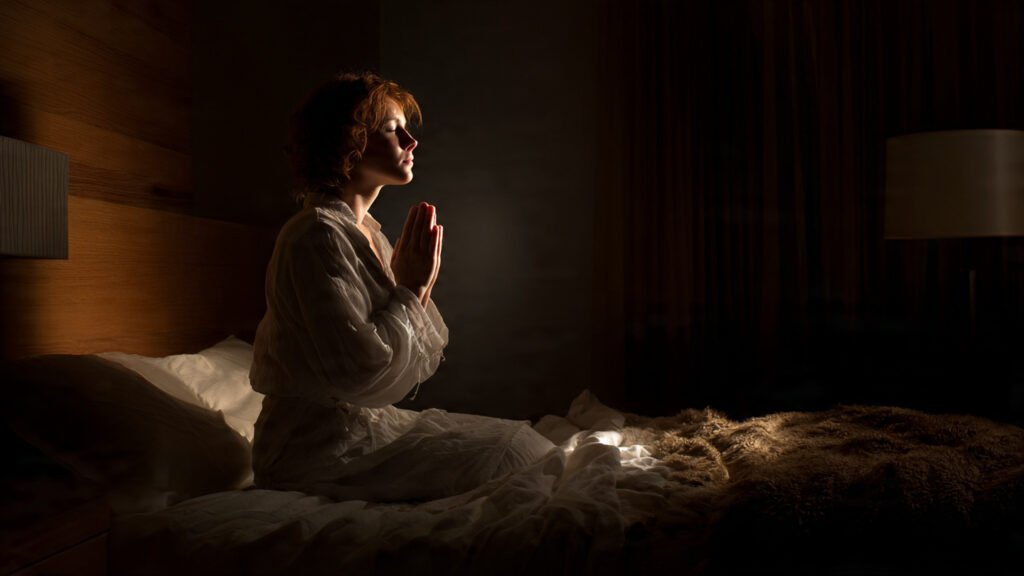
Reading is powerful, but praying is transformational. To truly unlock the power of praying the Psalms, we need to turn the theology into a conversation.
Many people get stuck because they think they can’t read a prayer from a page. But praying Scripture is one of the most ancient and potent forms of intercession. It aligns your will with God’s will.
A Prayer for When You Feel Unsafe (Based on Psalm 121) If you feel exposed or vulnerable, use the “Psalm of the Watchman.”
- The Script: “Father, I thank You that You are the Watchman of Israel who neither slumbers nor sleeps. Because You are awake, I can rest. I commit my safety, my health, and my family into Your keeping. Stand guard over my mind while I dream. Amen.”
A Prayer for When Your Mind Won’t Stop (Based on Psalm 139) If you feel like you can’t escape your own thoughts, use the “Psalm of Being Known.”
- The Script: “Lord, You have searched me and You know me. You know every anxious thought before I even think it. I thank You that I am hemmed in by Your love—behind and before. I cannot run from Your presence, and I don’t want to. Hold me fast tonight. Amen.”
Action Tip: The “Verse Card” on the Nightstand Don’t rely on your memory when you are panic-stricken. Write one of these prayers on an index card and tape it to your lamp or nightstand. When the anxiety hits at 2:00 AM, you won’t have to think; you just have to read.
Creating a Nightly “Psalm Habit”
Anxiety is often chronic, which means our remedy must be consistent. You wouldn’t take an antibiotic once and expect to be cured; in the same way, we need to dose ourselves with Truth nightly.
Building a bedtime prayer practice isn’t about legalism; it’s about building a muscle. The more you do it, the easier it becomes to switch your brain from “panic mode” to “peace mode.”
The 30-Day Challenge I challenge you to try this for one month.
- Pick One Psalm: Don’t bounce around. Choose one Psalm (like Psalm 23 or 91) to be your “Nightly Anthem.”
- Read it Aloud: There is power in hearing your own voice speak God’s Word. It interrupts the internal monologue.
- End with Thanksgiving: After reading, thank God for one specific thing from the day. This shifts your brain from “problem-scanning” to “grace-scanning.”
Audio Psalms for the Exhausted Sometimes, you are just too tired to keep your eyes open. That is okay. In those moments, let technology serve you. Use an audio Bible app or a sleep story app to play the Psalms over you as you drift off.
This is a passive way to soak in God’s protection at night. You are literally washing your subconscious mind with Scripture while you sleep.
Strategic Link: If you need more structure than just a single verse, or if you want a guide to walk you through this process every night, explore our full library of Bedtime Prayers for Adults. It’s designed to be the companion you need when the house is quiet and the mind is loud.
When Prayer Doesn’t Make the Anxiety Go Away Instantly
This is the hardest part of the journey, and we need to be honest about it. What happens when you read the Psalm, pray the prayer, and your chest is still tight? What happens when you cry out to God, and the panic attack doesn’t instantly evaporate?
It is easy to spiral into shame in these moments. The enemy loves to whisper, “See? It didn’t work. God isn’t listening. You aren’t doing it right.”
The Slow Work of Peace We live in an instant-gratification culture. We want peace to be like a light switch—flip it, and the darkness is gone. But in Scripture, peace is often described as a fruit (Galatians 5:22). Fruit doesn’t appear instantly; it grows.
When you pray Psalms for anxiety, you are planting seeds. Sometimes the relief is immediate, and that is a miracle. But other times, the peace grows slowly, root by root, as you consistently bring your fears to the Father. If you don’t feel better instantly, do not give up. You are doing the work of tilling the soil. You are retraining your brain to trust, and that takes time.
Seeking Professional Help is Biblical I want to be very clear: relying on God’s Word does not mean you ignore God’s other gifts. Doctors, therapists, and counselors are instruments of God’s grace.
If you had a broken leg, you would pray for healing, and you would go to a doctor to get a cast. Mental health is no different. If your anxiety is chronic, debilitating, or preventing you from functioning, reading Psalm 91 is powerful, but so is calling a counselor. Doing so is not a lack of faith; it is an act of wisdom. God uses both the Scripture and the science to bring us to wholeness.
Frequently Asked Questions About Praying the Psalms
Which Psalm is best for severe panic attacks? Psalm 91 is often the “go-to” for high-intensity fear because of its strong, protective imagery (“shield,” “refuge,” “fortress”). Psalm 61 is another powerful one: “From the end of the earth I call to you when my heart is faint.”
Did King David have anxiety? While the clinical term “anxiety disorder” didn’t exist then, David’s writings perfectly mirror the symptoms. He describes his bones shaking, his heart pounding, his sleep fleeing, and his groaning being too deep for words. He is the patron saint of the anxious believer, proving that you can struggle with your mind and still be a man after God’s own heart.
Is it okay to fall asleep while reading? Yes! In fact, that is the goal. There is no better way to end your day than drifting off mid-sentence in a conversation with your Creator. Don’t feel guilty; feel held.
How do I memorize these for when I wake up at night? Start small. Don’t try to memorize a whole chapter. Pick one “anchor phrase” like “When I am afraid, I put my trust in You” (Psalm 56:3). Repeat it throughout the day so it is ready for you at night.
Conclusion
Anxiety tries to tell you that you are unsafe, alone, and out of control. But the Psalms tell a different story. They tell the story of a God who is a Shepherd, a Fortress, a Shade, and a Father who sings over you while you sleep.
You do not have to conquer your anxiety in a single night. You don’t have to banish every “what if” scenario from your brain right now. You simply need to anchor yourself to the One who holds it all together.
David found peace in a cave while armies hunted him. You can find peace in your bedroom while your thoughts hunt you. The same God is present in both places.
Your Challenge Tonight Don’t just close this tab and hope for the best. Choose one Psalm from this list. Write it down or open it on your phone. Read it out loud before you turn off the light. Let the ancient words of God be the last thing that speaks to your soul tonight.
Next Steps If you are ready to make this a nightly habit, we want to walk with you. Bookmark our guide on Bedtime Prayers for Adults for more resources, scripts, and encouragement to help you end every day in His perfect peace.