
The Longing to Hear from God
You’re lying awake at night, wrestling with a decision that could change everything. You’ve prayed. You’ve searched Scripture. You’ve asked friends for advice. But there’s still a gnawing question underneath it all: Is God really speaking to me? How do I know?
If that feels familiar, you’re not alone. Countless sincere Christians carry this ache—a desperate longing to hear from God the way Abraham did at the altar, the way Moses experienced Him at the burning bush, the way David received wisdom in crisis. You read those biblical stories and wonder: Why does God seem so distant? Why can’t I hear His voice with that kind of clarity?
The painful truth? Many believers go years feeling disconnected from the voice of the God they’ve committed their lives to. They experience doubt, miss divine guidance, and settle for a faith that feels more like routine than relationship. Some eventually give up, assuming hearing God’s voice is reserved for prophets, pastors, or the super-spiritual elite.
But what if everything you’ve been told is wrong?
Jesus made an extraordinary promise: “My sheep hear my voice, and I know them, and they follow me” (John 10:27). Not “they might hear my voice.” Not “spiritual giants hear my voice.” He said His sheep—which includes you—hear His voice. This isn’t a promise about the past or the future. It’s a present-tense reality available to you right now.
The question isn’t whether God is speaking. He is. The question is whether you have the spiritual tools to recognize God’s voice, distinguish it from your own thoughts, and respond with confidence.
In this article, you’ll discover exactly how to hear God’s voice—the biblical ways He speaks today, the unmistakable signs of His presence, proven methods to discern His guidance from your own desires, and practical steps to develop deeper sensitivity to the Holy Spirit. By the end, you’ll have a clear framework for recognizing when God is speaking and the confidence to follow His lead.
Does God Still Speak Today?
Before exploring how to hear God’s voice, we need to establish a foundational truth: Yes, God still speaks today.
Some Christians inherit a theology that suggests God stopped speaking after the apostles died or after Scripture was completed. This view is called cessationism, and while well-intentioned, it contradicts the biblical narrative about God’s nature and relationship with His people.
God is not silent. He is a speaking God. Throughout Scripture, we see that communication is intrinsic to His character. He spoke creation into existence. He entered into dialogue with His people. He made covenants through spoken words. The entire Old Testament prophetic tradition is built on the premise that God actively speaks to people in each generation.
In the New Testament, Jesus promised that His followers would hear His voice: “My sheep hear my voice, and I know them, and they follow me” (John 10:27, ESV). This isn’t a promise about the past. It’s a present-tense statement about the ongoing relationship between Christ and His people.
Moreover, the Holy Spirit was given at Pentecost not as a historical monument but as an active, present agent in the Church. The Spirit guides believers into truth (John 16:13), brings Scripture to mind (John 14:26), and speaks to the hearts of God’s people (Romans 8:16). If the Spirit indwells us, He must speak to us. That’s what indwelling means.
God still speaks today, but He does so in ways that align with His completed revelation in Scripture and through the ongoing presence of His Holy Spirit. Understanding how He speaks is crucial to developing a listening ear.
What the Bible Says About Hearing God’s Voice
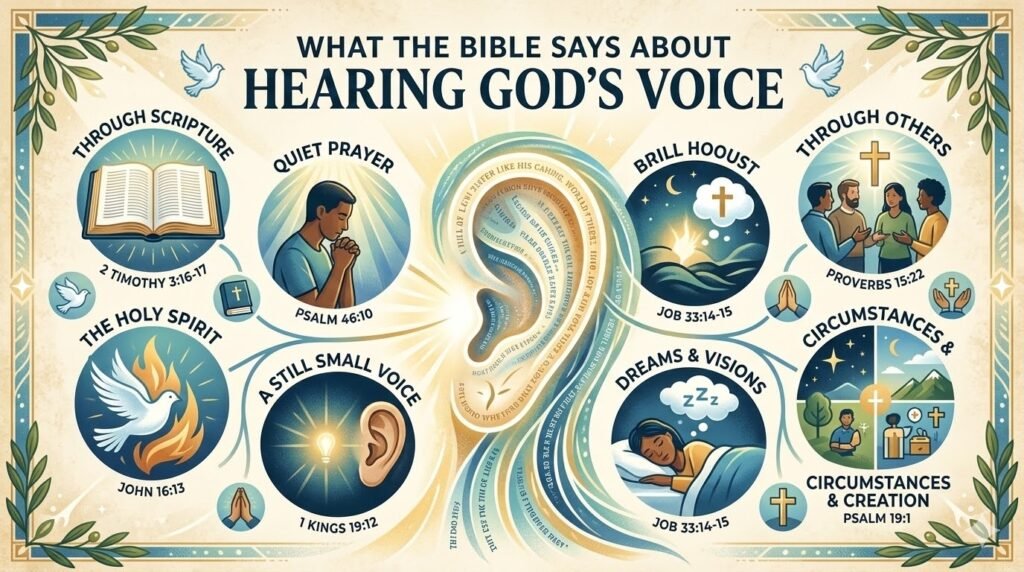
Scripture provides several foundational passages about how God communicates with His people today. Let’s examine the most important ones.
John 10:27 – The Voice of the Shepherd
“My sheep hear my voice, and I know them, and they follow me” (ESV).
Jesus uses the metaphor of a shepherd and sheep to describe His relationship with believers. Sheep are uniquely attuned to their shepherd’s voice. In Middle Eastern culture, shepherds don’t drive sheep with force; they lead them with a familiar voice. The sheep recognize that voice amid a cacophony of other sounds because they know their shepherd intimately.
This passage reveals several truths about hearing God’s voice:
- Hearing is normal. Jesus expects His followers to hear His voice as a regular part of their walk with Him.
- Recognition requires relationship. Sheep know their shepherd’s voice because they spend time with him. We recognize God’s voice through intimate time in prayer and Scripture.
- Obedience follows recognition. The sheep “follow” when they hear. Hearing God’s voice naturally produces obedience, not confusion or contradiction.
1 Kings 19:11–12 – The Still Small Voice
“Then a great and powerful wind tore the mountains apart and shattered the rocks before the Lord, but the Lord was not in the wind. After the wind there was an earthquake, but the Lord was not in the earthquake. After the earthquake came a fire, but the Lord was not in the fire. And after the fire came a gentle whisper” (NIV).
This passage occurs when the prophet Elijah is hiding in a cave, discouraged and exhausted. God performs dramatic displays—wind, earthquakes, fire—but He’s not in any of them. Instead, He speaks in a “still small voice,” often called a “gentle whisper.”
This reveals that God doesn’t always speak in the dramatic, unmistakable ways we might expect. Often, His voice comes as an inner whisper to the soul—a quiet prompting, a subtle impression, a deep knowing. This is the most common way many believers experience God speaking today.
Isaiah 30:21 – The Path Made Clear
“Whether you turn to the right or to the left, your ears will hear a voice behind you, saying, ‘This is the way; walk in it'” (NIV).
Isaiah promises that God actively guides His people. His voice comes not to confuse but to clarify. When we face decisions or crossroads, God speaks to direct us “in the way.” The voice described here is constant and attentive—always available, always guiding, as reliable as a voice immediately behind you.
Hebrews 1:1–2 – How God Speaks in This Age

“In the past God spoke to our ancestors through the prophets at many times and in various ways, but in these last days he has spoken to us by his Son” (NIV).
This passage establishes that God has always spoken in “various ways.” He spoke through burning bushes, dreams, prophets, circumstances, and inner promptings. But in the New Testament era, His primary revelation comes through Jesus Christ and is recorded in Scripture. However, the Holy Spirit continues to speak through these same varied channels, applying God’s truth to our specific situations.
God has not stopped speaking. He has clarified that all His speaking is consistent with the revelation of Christ in Scripture.
Section 3: 12 Biblical Ways God Speaks to His People
Now that we understand God still speaks, let’s explore the primary ways He communicates with believers today. Recognizing these channels will help you identify God’s voice in your life.
1. Through Scripture – God’s Written Word
The most foundational way God speaks today is through the Bible. Scripture is God’s eternal, unchanging Word. When you read the Bible, you’re hearing from God directly.
Biblical Example: The Ethiopian eunuch in Acts 8 was reading Isaiah 53 when the Holy Spirit used that Scripture to reveal Jesus to him. The Word itself became the vehicle for God’s voice.
Modern Example: You’re struggling with anxiety and randomly open to Philippians 4:6–7, where Paul writes about casting anxious thoughts on God through prayer. In that moment, God speaks directly to your situation through His written Word.
Discernment Guidance: God will never speak through Scripture in a way that contradicts the biblical message as a whole. When considering whether God is speaking through Scripture, ask: Does this align with the character of Christ? Does it square with the broader biblical narrative? Is it consistent with God’s love and holiness?
One of the biggest spiritual challenges is distinguishing divine guidance from personal thoughts or emotions. This guide on how to discern God’s voice vs your own thoughts explains how believers can test what they hear through scripture and spiritual wisdom.
2. Through the Holy Spirit – Inner Impressions and Promptings
The Holy Spirit indwells believers and speaks to the deepest part of our being. This is often experienced as an inner knowing, an impression, or a prompting—thoughts that arise that feel distinctly “not you” in origin.
Biblical Example: In Acts 13:2, “While they were worshiping the Lord and fasting, the Holy Spirit said, ‘Set apart for me Barnabas and Saul for the work to which I have called them'” (NIV). The Holy Spirit spoke directly to the church, creating a unified sense of divine direction.
Modern Example: You’re conversing with a friend who mentions a prayer request, and suddenly you sense a strong inner prompting to pray for them right then and there. That prompting is the Holy Spirit speaking.
Discernment Guidance: Impressions from the Holy Spirit will bear the “fruit of the Spirit”—they’ll move you toward love, joy, peace, patience, kindness, goodness, faithfulness, gentleness, and self-control (Galatians 5:22–23). The Holy Spirit never rushes, condemns, or contradicts Scripture.
3. Through the Still Small Voice – Quiet Inner Knowing
Distinct from dramatic visions or audible words, God often speaks as a quiet inner voice—a gentle knowing that settles in your spirit. This is the “still small voice” mentioned in 1 Kings 19:12.
Biblical Example: When Peter was in a trance and God was preparing him to visit Gentile believers, the Spirit spoke to him: “Get up, Peter. Kill and eat” (Acts 10:13). This wasn’t necessarily audible; it was a clear inner communication.
Modern Example: You’re considering a job opportunity that looks good on paper, but as you pray, a quiet voice within says, “This isn’t my will for you.” You can’t articulate why, but there’s a settled knowing in your spirit that this isn’t the path God is calling you to.
Discernment Guidance: The still small voice will be characterized by peace or conviction—never panic or pressure. God’s inner voice creates a sense of alignment in your spirit. If you feel agitated, unsettled, or pressured, that’s likely your own thoughts or emotions, not the Holy Spirit.
Many believers struggle with identifying whether a thought comes from the Holy Spirit or from their own mind. Learning how to recognize the voice of God can help you understand the spiritual signs that reveal His guidance.
4. Through Prayer and Dialogue with God

Sometimes God speaks most clearly when we’re directly talking to Him. In prayer, we often find clarity, direction, and divine wisdom emerging as we bring our requests and questions before the Father.
Biblical Example: In Luke 1:11–13, Zechariah was praying in the temple when an angel appeared to him with a message from God. His prayer created the context for God’s communication.
Modern Example: You’ve been wrestling with a difficult decision and pray about it repeatedly. In the midst of your prayer time, thoughts suddenly crystallize, confusion lifts, and you sense God’s answer. That clarity emerging through prayer is God speaking.
Discernment Guidance: When seeking God’s voice through prayer, speak honestly, listen in silence, and pay attention to the thoughts that emerge. Not every thought during prayer is from God, but the ones that create peace, align with Scripture, and persist across multiple prayer sessions usually are.
5. Through Peace – The Witness of the Spirit
God often speaks through the presence or absence of peace. Colossians 3:15 says, “Let the peace of Christ rule in your hearts, to which indeed you were called in one body” (ESV). The word “rule” here means to umpire or judge. God’s peace acts as an arbiter in our decision-making.
Biblical Example: When Paul and his companions were imprisoned in Philippi (Acts 16:25–26), they prayed and sang hymns at midnight. God responded not only with an earthquake but with their own inner peace in the midst of suffering. That peace was God’s voice affirming His presence.
Modern Example: You’re facing two seemingly good options. With one option, you feel settled, peaceful, and at rest. With the other, you feel agitated and unsettled despite logical reasons to choose it. The presence of peace is God’s voice directing you.
Discernment Guidance: God’s peace isn’t merely emotional comfort. It’s a deep, grounded sense of alignment with His will—even when circumstances are difficult. Ask yourself: Am I at peace about this decision when I genuinely surrender it to God’s will? That’s the peace of God speaking.
6. Through Conviction – God’s Voice Against Sin
The Holy Spirit convicts believers of sin (John 16:8). This conviction is distinct from shame or condemnation. Conviction invites us to repentance and restoration; shame and condemnation drive us to hide and despair.
Biblical Example: When Nathan the prophet confronted King David about his sin with Bathsheba, David’s conscience was awakened to his wrongdoing. That conviction led to genuine repentance (Psalm 51).
Modern Example: You’re tempted to exaggerate the truth in a business conversation. As you open your mouth, the Holy Spirit convicts you—a gentle but unmistakable awareness that this would be dishonest. That conviction is God’s voice protecting you from sin.
Discernment Guidance: Genuine conviction from the Holy Spirit is specific (pointing to a particular sin), gentle (inviting change, not crushing shame), and productive (leading to repentance and restored relationship with God). If you’re experiencing vague guilt or crushing shame, that’s likely not the Holy Spirit’s voice.
7. Through Circumstances – God’s Providential Hand
God often speaks through the circumstances He orchestrates in our lives. Open doors and closed doors, opportunities and obstacles, all can be God’s way of communicating His will.
Biblical Example: In Acts 16:6–10, Paul and his companions were “forbidden by the Holy Spirit to speak the word in the province of Asia.” Then they saw a vision of a man from Macedonia calling them to come help. The closed doors and the open door were God speaking about His missionary call.
Modern Example: You’ve been praying about whether to pursue a certain ministry opportunity. A series of circumstances unexpectedly aligns—someone you respect suggests it, a financial provision appears, and a key relationship develops that makes the path clear. God is often speaking through these providential alignments.
Discernment Guidance: Circumstances alone aren’t enough to determine God’s will. They must align with Scripture, produce peace, and typically be confirmed in multiple ways. Ask: Do the circumstances align with God’s character? Do they align with Scripture? Do they produce peace?
The Bible teaches that God communicates with His people through the guidance of the Holy Spirit. This article explains how the Holy Spirit speaks to believers and the biblical ways He leads, teaches, and convicts Christians today.
8. Through Wise Counsel – The Voice of Community

“Where there is no guidance, a people falls, but in an abundance of counselors there is safety” (Proverbs 11:14, ESV). God often speaks through the wisdom and counsel of mature believers who know Scripture and know you.
Biblical Example: In Acts 15, the early church faced a critical question about whether Gentile converts needed to follow Jewish law. God’s will became clear through the counsel of the apostles and church leaders gathered together, discussing Scripture and seeking wisdom.
Modern Example: You’re facing a major life decision and seek counsel from a mentor, pastor, or trusted Christian friend. As they share wisdom grounded in Scripture and their own experience, something they say resonates deeply and clarifies God’s direction for you.
Discernment Guidance: Seek counsel from people who know Scripture, know God’s character, and have proven spiritual maturity. Be cautious of counsel that flatters your desires, contradicts Scripture, or comes from those with hidden agendas. Good counsel will be consistent with Scripture and affirm what the Holy Spirit is already speaking to your heart.
9. Through Spiritual Promptings – Divine Nudges
Sometimes God gives us nudges or promptings to do specific things—reach out to a friend, serve in a particular way, speak up about something. These are often subtle but persistent.
Biblical Example: In Acts 10, Peter received a vision prompting him to go to the Gentile Cornelius’s house, breaking Jewish cultural boundaries. The prompting was repeated because it was important to God’s expanding mission.
Modern Example: You feel a prompting to call an old friend you haven’t thought about in years. You do, and discover they’re in crisis and desperately need prayer. That prompting was God’s voice directing you to someone who needed you.
Discernment Guidance: Genuine spiritual promptings will align with Scripture and God’s character. They’ll often persist (recurring to your mind) and usually invite you toward love, service, or faithfulness. Test them against Scripture and seek confirmation through circumstances or counsel.
10. Through Dreams and Visions
While less common in Western Christian experience, Scripture affirms that God can speak through dreams and visions. Joel 2:28–29 promises that in the last days, God will pour out His Spirit and people will “see visions” and “dream dreams.”
Biblical Example: Joseph received multiple dreams revealing God’s will for his life and family (Genesis 37). In Matthew 1:20, Joseph received a vision that clarified God’s plan regarding Mary and Jesus.
Modern Example: A believer experiences a vivid dream that leaves a deep spiritual impression. Upon waking, they sense God has communicated something important about a relationship or direction in life.
Discernment Guidance: Dreams and visions require careful discernment. Not all dreams are from God; many are simply our subconscious processing. However, if a dream produces persistent spiritual impact, aligns with Scripture, brings peace, and possibly receives confirmation through other means, God may be speaking. Always test visions against Scripture.
11. Through Music and Worship

God sometimes speaks powerfully through music and worship. A song lyric, a melody, or a worship experience can become a vehicle for God’s voice, touching something deep in our spirits.
Biblical Example: When David was troubled by an evil spirit, young David would play the harp, and the music would soothe Saul (1 Samuel 16:23). Music became therapeutic and spiritually restorative. Often, God speaks through music’s power to touch the soul.
Modern Example: During worship at church, a particular song lyric suddenly feels like God is singing directly to your situation. You find yourself weeping as you recognize God’s specific message through the words and melody.
Discernment Guidance: God may speak through music, but the message must align with Scripture and His character. Don’t base major life decisions solely on emotional responses to music. However, if a song reinforces something God has been saying through other channels, it may be confirmation.
12. Through Nature and Creation
Creation speaks to us about God’s character, power, and presence. David wrote, “The heavens declare the glory of God; the skies proclaim the work of his hands” (Psalm 19:1, NIV). Sometimes God speaks through the natural world.
Biblical Example: In Job, God speaks to Job through creation, pointing him toward the natural world’s testimony to God’s wisdom and power (Job 38–41). Creation itself becomes God’s voice revealing His majesty.
Modern Example: You’re struggling with God’s faithfulness, and while hiking in nature, the vastness of creation—towering mountains, endless forests, flowing streams—suddenly overwhelms you with a sense of God’s power and care. In that moment, nature itself communicates God’s presence.
Discernment Guidance: God’s voice through nature will point you toward His glory, power, and character. It won’t contradict Scripture. Use it as confirmation and meditation rather than as a primary source of guidance for specific decisions.
7 Signs God Is Speaking to You
Not every thought or impression is from God. How do you know if God is actually speaking? Here are seven reliable signs.
1. The Message Aligns with Scripture
God will never speak something that contradicts His written Word. If a supposed word from God asks you to act unethically, abandon biblical truth, or compromise righteousness, it’s not from God. This is the primary test.
2. The Message Produces Peace, Not Panic
“Let the peace of Christ rule in your hearts” (Colossians 3:15). God’s voice creates peace. If you’re sensing panic, pressure, urgency driven by fear, or anxiety, that’s likely not God. God may call you to courageous action, but it will be undergirded by peace.
3. The Message Calls You Toward Righteousness and Love
The fruit of the Holy Spirit is love, joy, peace, patience, kindness, goodness, faithfulness, gentleness, and self-control (Galatians 5:22–23). God’s voice always invites you toward these qualities. Any message calling you toward selfishness, bitterness, unforgiveness, or harm isn’t from God.
4. The Message Is Consistent Across Multiple Confirmations
When God speaks, He often confirms the message through multiple channels—Scripture, prayer, circumstance, counsel, inner peace. If you sense God is directing you a certain way, pay attention when the same direction appears in a sermon, a conversation, a passage you randomly open, or your prayer time. God isn’t confused; He speaks in unified ways.
5. The Message Respects Your Freedom and Intelligence
God respects the mind and will He gave you. He doesn’t override your capacity to think, reason, and choose. If something feels like it’s violating your agency or manipulating your will, it’s not from God. God invites, directs, and guides; He doesn’t control or manipulate.
6. The Message Produces Spiritual Fruit, Not Spiritual Pride
When God speaks and you obey, the result is spiritual growth—increased faith, deepened love, greater humility, expanded fruitfulness. If God’s supposed guidance makes you arrogant, judgmental toward others, or spiritually superior, that’s a red flag. God’s voice humbles us; it doesn’t puff us up.
7. The Message Draws You Closer to Jesus and His Kingdom
Ultimately, every word from God in this age directs us toward Jesus. Jesus said, “All the scriptures… testify about me” (John 5:39, NIV). If God’s voice is drawing you toward Jesus, deeper faith, increased obedience, and kingdom purposes, you can be confident it’s from Him.
How to Discern God’s Voice vs. Your Own Thoughts
One of the greatest challenges in learning how to hear God’s voice is distinguishing it from your own thoughts, desires, and emotions. Here’s how to develop that discernment.
Understand the Nature of Your Thoughts
Your thoughts are often characterized by these patterns:
- Self-centered. Your thoughts typically revolve around your desires, fears, and perspectives.
- Repetitive and anxious. Anxious thoughts tend to spiral and repeat rather than resolve.
- Emotional and reactive. Your thoughts respond emotionally to circumstances.
- Often contradictory. One moment you think one thing; the next, you think the opposite.
Understand the Nature of God’s Thoughts
God’s thoughts, as communicated through His voice, carry distinct characteristics:
- Others-centered. God’s direction typically invites you toward serving, loving, or helping others.
- Clarifying and peaceful. God’s voice creates resolution, clarity, and peace, not confusion.
- Stable and consistent. God’s direction doesn’t keep changing with your moods or circumstances.
- Often surprising. God’s thoughts are often higher than our thoughts (Isaiah 55:8–9) and sometimes call us in directions we wouldn’t naturally choose.
Ask the Four Questions
When you sense God speaking, ask yourself:
1. Does this align with Scripture?
Search your Bible for relevant passages. If God is speaking, it will be consistent with His revealed truth.
2. Does this produce peace?
When you genuinely surrender the situation to God and accept His direction, do you feel peace? Or do you feel agitation, panic, or dread?
3. Does this invite me toward righteousness and love?
Would acting on this lead to greater faith, more love for God and others, and increased righteousness?
4. Is this confirmed in multiple ways?
Has God confirmed this direction through Scripture, prayer, circumstance, and counsel?
If you can answer “yes” to all four questions, you likely have heard from God.
Pay Attention to the Sender’s Character
The origin of a message reveals its nature. Your own thoughts originate from your fallen, limited nature. God’s thoughts originate from infinite wisdom, perfect love, and absolute holiness. The message’s character—its kindness, wisdom, and moral purity—often reveals its source.
Practice Discernment Over Time
Discerning God’s voice isn’t an instant skill; it’s developed over time through practice. The writer of Hebrews speaks of believers who have “trained themselves to distinguish good from evil” (Hebrews 5:14, NIV). The word “trained” suggests practice and experience.
Over time, as you practice listening, testing, and obeying God’s voice, your spiritual ears become increasingly attuned to His voice and increasingly resistant to counterfeits.
Common Mistakes Christians Make When Trying to Hear God

Understanding common pitfalls will help you avoid them and hear God’s voice more clearly.
Mistake 1: Expecting an Audible Voice
Many believers wait for a dramatic, audible word from God—the way He spoke from Mount Sinai or through the prophets. When that doesn’t happen, they assume God isn’t speaking. But most believers in history have experienced God speaking as an inner voice or impression, not audibly. Expecting an audible word sets you up for disappointment.
Mistake 2: Seeking Guidance Without Seeking God Himself
We can become so focused on getting an answer from God that we forget we’re seeking the God who loves us. When your primary aim is extracting direction from God rather than deepening relationship with Him, you’ll miss His voice. Seek Him first; guidance will follow.
Mistake 3: Ignoring Scripture in Pursuit of Specific Direction
Some Christians treat Scripture as secondary and seek direct revelation for every decision. But God will never speak in a way that contradicts Scripture. Make Scripture your foundation, and any true guidance will align with it.
Mistake 4: Rushing to Act Before Confirming God’s Voice
Impatience is the enemy of discernment. When you feel pressured to act quickly on a supposed word from God, slow down. God isn’t in a hurry, and He won’t push you to move before you have clarity. Real conviction produces peace, even in urgency.
Mistake 5: Seeking God’s Voice for Minor Decisions
Not every decision requires a specific word from God. God has given you wisdom, intelligence, and the Holy Spirit to guide your reasoning. It’s fine to seek His guidance on major decisions (career, marriage, relocation) while trusting your judgment on smaller matters. Overthinking every decision paralyzes you from functioning as a mature believer.
Mistake 6: Expecting God to Make All Your Choices
God invites you to partnership with Him, not passive dependence. He expects you to think, reason, seek wisdom, and make decisions. He’ll guide and direct, but He won’t remove your responsibility to grow in discernment and decision-making.
Mistake 7: Letting Emotion Trump Discernment
Powerful emotions can feel like divine direction. You feel passionate about something and assume it’s from God. But feelings are valid without being divine. Test emotional experiences against Scripture, peace, and multiple confirmations before acting.
How to Become More Sensitive to the Holy Spirit

Your sensitivity to God’s voice can grow. Like any relationship, your ability to hear God increases with intentional practice. Here are practical ways to develop greater sensitivity.
1. Spend Regular Time in Scripture
The Holy Spirit speaks through God’s Word. Daily Bible reading and meditation attune your ear to God’s voice. As you internalize Scripture, you’ll increasingly recognize when the Spirit is applying biblical truth to your life.
2. Practice Intentional Prayer
Prayer isn’t just bringing requests to God; it’s listening to Him. In your prayer time, spend time in silence. Ask God to speak, then listen. Often, the thoughts that emerge during prayer are the Holy Spirit’s voice.
3. Obey What You Already Know
The clearest barrier to hearing new direction from God is disobedience to what He’s already said. If you’re ignoring biblical convictions or neglecting spiritual disciplines, why would God entrust you with further guidance? Obedience opens your ears.
4. Cultivate Sensitivity to the Fruit of the Spirit
God’s voice produces spiritual fruit. The more you recognize and cultivate love, joy, peace, patience, kindness, goodness, faithfulness, gentleness, and self-control in your life, the more attuned you become to the Holy Spirit’s presence and voice.
5. Reduce Spiritual Noise
Our culture is loud. Our minds are distracted. God’s still small voice is easily drowned out. Regularly create space of silence and solitude. Walk without music. Sit without your phone. In stillness, you’ll hear more clearly.
6. Keep a Journal of God’s Guidance
When you sense God speaking, write it down. Record what you sensed, when, and what circumstances surrounded it. Over time, you’ll develop a record of how God speaks to you personally. You’ll also see patterns—ways He consistently communicates with you.
7. Seek Accountability and Community
Share your spiritual journey with mature believers. Allow them to help you discern whether what you sense is truly from God. The wisdom of community protects against deception.
8. Ask the Holy Spirit to Teach You
Don’t assume discernment is something you accomplish alone. Ask the Holy Spirit: “Teach me your voice. Make me increasingly sensitive to your presence and guidance.” God is eager to tutor His children in discernment.
A Simple Prayer to Help You Hear God’s Voice
Use this prayer as a foundation for seeking clarity about how to hear God’s voice:
Father, I want to hear your voice. I confess that sometimes I’m uncertain whether you’re speaking or whether I’m just hearing my own thoughts. I ask you to make me increasingly sensitive to the Holy Spirit’s presence and guidance.
Help me to recognize your voice in Scripture, in the still small voice within me, in circumstances you orchestrate, and in the wise counsel of others. Make me more attuned to your presence than to the noise of the world.
I commit to obeying what I already know you’ve revealed. I commit to testing any word I sense from you against your Scripture, your character, and your kingdom purposes. Give me wisdom to discern your voice from counterfeits.
Make me patient in waiting for clarity, rather than rushing ahead in presumption. Deepen my intimacy with you so that I increasingly recognize your voice as easily as I recognize the voice of a beloved friend.
I submit my will, my plans, and my life to your guidance. Speak, Lord. Your servant is listening.
In Jesus’s name, Amen.
Bible Verses About Hearing God’s Voice
Here are key scriptures that address how to hear God’s voice:
- John 10:27 – “My sheep hear my voice, and I know them, and they follow me.”
- 1 Kings 19:11–13 – God speaks not in wind, earthquake, or fire, but in a still small voice.
- Isaiah 30:21 – “Whether you turn to the right or to the left, your ears will hear a voice behind you, saying, ‘This is the way; walk in it.'”
- Hebrews 1:1–2 – “In the past God spoke to our ancestors through the prophets at many times and in various ways, but in these last days he has spoken to us by his Son.”
- John 14:26 – “The Counselor, the Holy Spirit, whom the Father will send in my name, will teach you all things and will remind you of everything I have said to you.”
- Romans 8:14 – “Those who are led by the Spirit of God are the children of God.”
- Proverbs 11:14 – “Where there is no guidance, a people falls, but in an abundance of counselors there is safety.”
- Colossians 3:15 – “Let the peace of Christ rule in your hearts, to which indeed you were called in one body.”
- 1 John 4:1 – “Dear friends, do not believe every spirit, but test the spirits to see whether they are from God, because many false prophets have gone out into the world.”
- Psalm 25:4–5 – “Show me your ways, Lord, teach me your paths. Guide me in your truth and teach me, for you are God my Savior, and my hope is in you all day long.”
Frequently Asked Questions About Hearing God’s Voice
How do I know if God is speaking to me?
Look for the seven signs mentioned earlier: alignment with Scripture, peace rather than panic, movement toward righteousness and love, consistency across multiple confirmations, respect for your freedom, spiritual fruit, and direction toward Jesus and His kingdom. When these elements are present, you can be confident God is speaking.
Does God speak audibly today?
While the Bible affirms that God can speak audibly (He’s God, after all), it’s relatively rare in contemporary Christianity. God more commonly speaks through His inner voice, Scripture, circumstances, counsel, and other means. Don’t wait for an audible word; be attentive to how He typically speaks.
Why can’t I hear God’s voice?
There are several possible reasons: you may not have quieted yourself enough to hear His still small voice amid life’s noise; you may be disobeying known convictions, which muffles His voice; you may be seeking direction without seeking Him; you may have unrealistic expectations about how He speaks; or you may be listening for His voice in the wrong places. Address each of these by refocusing on Scripture, prayer, obedience, and community.
Can God speak through dreams?
Yes. Scripture affirms that God can communicate through dreams (Joel 2:28, Matthew 1:20, Acts 16:9). However, not every dream is from God. Test dreams against Scripture, their impact on your spiritual life, and whether they align with God’s character. If a dream persistently impacts you spiritually and aligns with Scripture, God may be speaking.
What if I miss God’s direction?
God’s grace is greater than your mistakes. If you miss His direction because you misheard or misunderstood, He’s patient and will guide you forward. He’s more committed to your spiritual growth than you are, and He won’t abandon you because of a mistake.
Can demons or my own flesh pretend to be God’s voice?
Yes. This is why testing is essential. Dark spiritual forces and our own desires can create false impressions. This is why the four questions (alignment with Scripture, peace, movement toward righteousness, confirmation) are so important. They act as a filter against deception.
How long should I wait for God to speak about a decision?
There’s no fixed timeline. Some decisions require immediate action based on wisdom and Scripture; others benefit from extended prayer and discernment. Don’t rush major decisions, but don’t use “waiting for God” as an excuse for procrastination. Often, once you’ve prayed, sought counsel, and searched Scripture, you have enough clarity to move forward in faith.
Does God speak differently to different people?
Yes. God knows your personality and how you best receive communication. Some people sense His voice most clearly through Scripture, others through nature, others through inner impressions. Over time, you’ll discover your own spiritual language—the primary ways God communicates with you.
Final Thoughts: Growing in Your Capacity to Hear God’s Voice
Learning to recognize and respond to God’s voice is among the most transformative pursuits of the Christian life. It’s the path to intimacy with the living God, to obedience that produces blessing, and to a faith that’s dynamic and alive rather than static and dead.
The good news is that God wants to speak to you far more than you want to hear from Him. Jesus promised, “My sheep hear my voice.” You aren’t an exception to that promise. You’re invited into the reality of hearing from God—not occasionally, but as a regular, sustaining dimension of your relationship with Him.
Begin where you are. Commit to regular Bible reading and prayer. Create space for silence. Test what you sense against Scripture. Seek counsel from mature believers. Obey what you already know. Over time, your spiritual ears will become increasingly attuned to God’s voice. What once felt uncertain will become increasingly familiar. What once required intense discernment will become as natural as recognizing a beloved friend’s voice in a crowd.
Your life is meant to be a conversation with God—not a monologue where you do all the talking, but a genuine dialogue where you listen as much as you speak. That dialogue is available to you now. God is speaking. The question is: Will you develop the spiritual maturity to hear Him?
Start today. Find a quiet place. Open Scripture. Bring your heart before God in honest prayer. Listen for His voice—in the words you read, in the impressions that come, in the peace that settles over your spirit. Invite the Holy Spirit to teach you His voice.
The Bible shows that God often speaks in a quiet and gentle way rather than through dramatic events. Understanding the still small voice of God can help believers become more sensitive to the subtle ways the Holy Spirit communicates.
Your Father is speaking. Listen well.
What experiences have you had with hearing God’s voice? How has God spoken to you most clearly? Share your story in the comments below—your experience may encourage another believer to listen more intently for God’s voice in their own life.